
Netflix’s new documentary series attempts to offer a deeper picture of who Aaron Hernandez was.
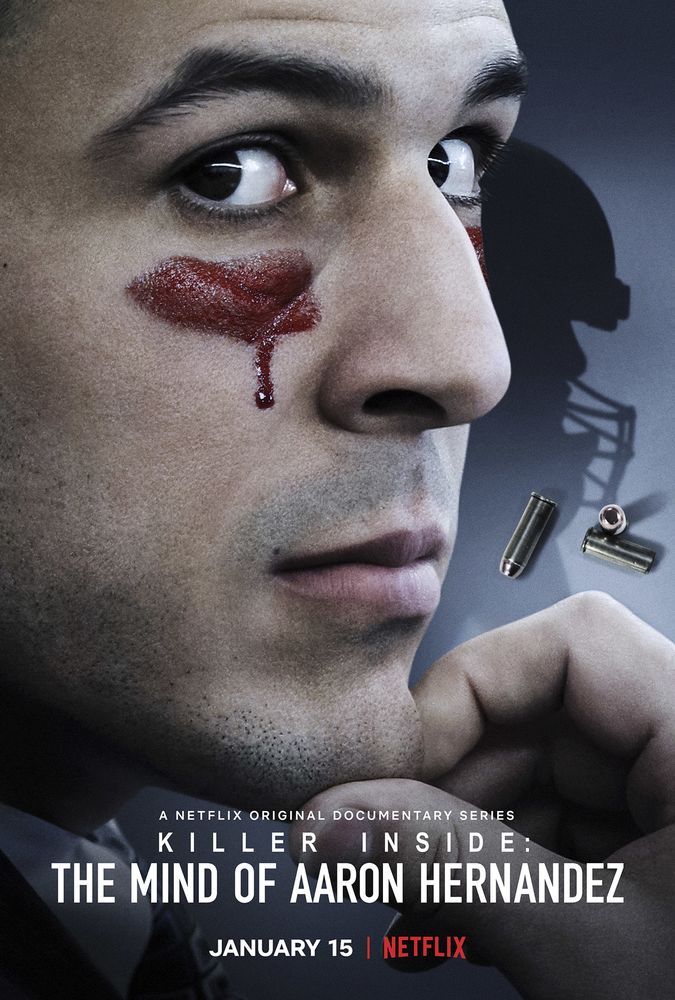
In Netflix’s newest true-crime documentary series, “Killer Inside: The Mind of Aaron Hernandez,” sexuality plays an important role in understanding the complex person of Hernandez. While the documentary certainly doesn’t imply it was Hernandez’s sexuality which caused him to kill, it does propose that perhaps his quick temper and deep-seated anger had roots in his frustration and struggle with identifying and hiding his sexuality.
To briefly summarize, in 2013, Hernandez was charged with murdering Odin Lloyd, someone who by all accounts could be considered a friend of Hernandez. Lloyd was also the boyfriend of the sister of Hernandez’s fiancee. While law enforcement was investigating Hernandez’s role in Lloyd’s death, they linked him o the murder of Daniel de Abreu and Safiro Furtado in 2012. Hernandez was found guilty in Lloyd’s death and sentenced with life in prison. In the trial for the 2012 murders, Hernandez was acquitted but days later was found dead in his jail cell. His death was ruled a suicide.
As the documentary reveals, the life of Aaron Hernandez was riddled with pain-both physically and emotionally. He grew up in an unstable household with an abusive father, caved into drug addictions and had one of the worst cases of CTE for a person of his age (Hernandez was 27 when he died).
But, as the documentary suggests, the torment of never acknowledging and hiding his sexuality might have been one of Hernandez’s greatest struggles. It’s easy to conceptualize the home life and values Hernandez was taught with an anecdote from his brother, D.J.’s book. D.J. tells of a time when Aaron, inspired by his female cousins, didn’t want to be a football player but rather a cheerleader. Hernandez’s father, Dennis, as the documentary says “put an end to that very quickly.” Like most young boys, Aaron idolized his father and was desperate for his approval; even if that meant shunning an important aspect of himself.
To provide further understanding into the potential inner conflict of being a queer athlete, the documentary interviews Ryan O’Callaghan, a now openly gay former NFL player. O’Callaghan, who played offensive tackle for the Patriots, explains how for him, football served as the ultimate coverup for his true sexuality. It was his beard. “Just in general, football is a very masculine sport and I relied on all the stereotypes of a football player. Just a lot of testosterone and the aggressiveness and hitting each other, all these things that you would assume middle America wouldn’t think of a gay men” he explains.
When O’Callaghan did come out as gay in 2017, through the LGBT publication “Outsports,” the feedback was reported to be overwhelmingly positive. In a USA Today article discussing the reaction to O’Callaghan’s coming out, he said “If I knew the response would be so overwhelmingly positive — that people would still love me and everything would be fine — yeah, I would’ve come out. That (closeted) life was exhausting.”
In 2017, shortly after Hernandez was acquitted for the 2012 murders, a journalist outed Hernandez as struggling with his sexuality in a radio interview. The journalist was attempting to link Hernandez’s sexuality as his motive for killing Lloyd. This motive has never been proved and two days later Hernandez would be dead.
We’ll never know if and how much being outed effected Hernandez as he paced endlessly between the same four walls of his cell but we do know it was a massive area of conflict for him. I’m by no means claiming that if Hernandez had defined his sexuality he wouldn’t have killed three people nor am I implying that not defining himself played a role in his killings. What I am saying, is, as the documentary hints at, perhaps if Hernandez had a person he could confidently confide in then maybe things would be different. Because at least if Hernandez had seriously talked about who he wanted to be he would have had one less conflict plaguing his mind.

 The Beat @APU