
The Coronavirus (Covid-19) has completely consumed our lives with the extremity of the situation. The New York Times published an essay by a woman who’s husband has contracted Coronavirus.
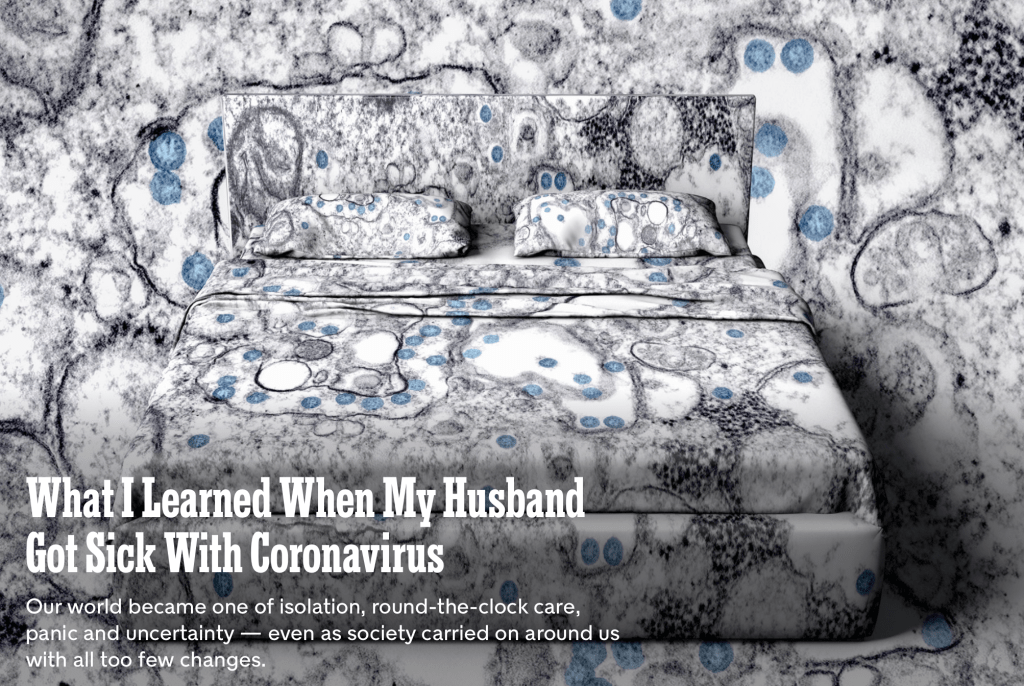
Set in a small flat in New York, the essay remains up close and personal. Her husband, known as “T” desperately needs her in this dire time. Having her support is a luxury that isn’t a guarantee for everyone who has been diagnosed with Covid-19.
The family has sacrificed a lot to try and help their husband and father. A teenage daughter never thought they would see their active and healthy loved one bedridden for days. The medical battle for their family was constantly changing.
“[he] has been lying on his back, staring at the ceiling, or curled on his side, wearing the same pajama bottoms for days because it is too hard to change out of them, too hard to stay that long on his feet, too cold outside the sheets and blankets he huddles beneath.”
T goes through the muddled process of paperwork and pamphlets desperately trying to do the right thing for his family and cat. Some things are unpreventable.
“He is considered high risk with what his medical chart calls “severe” asthma that sent him to the emergency room with an acute attack a few months ago.”
This is how most cases of Coronavirus have started to become serious—pre-existing medical conditions.
Right now, most family living rooms are parallel to each other. Board games, blankets and other clear signs of boredom. This is not the case for the family whose loved one has contracted the virus. T’s wife, and writer of the essay has been sleeping on the floor while her husband stays quarantined in the room. Sleeping on the floor is ideal compared to the pains of watching her husband suffer through the unknown Coronavirus.
By March 13, her husband was joined by thousands of others in pain.
“I tiptoe closer and bend to make sure he is alive, to make sure he is still breathing.”
This is a nightmare for anyone. Her days are filled with facetime calls to hospitals, cleaning and scavenging the area for medicine. Anything she sees that can help distract T, maybe a budding flower or bird outside the window.
Together, they make it outside of the shrinking apartment into a clinic to visit his doctor, where simple tasks are completely draining. The news was that home was destined to be the place of recovery for T.
Despite the grueling work of taking care of someone with Coronavirus, the author claims there are still reasons to be grateful. Her relationship with her daughter has grown to new levels.
“I feel like we’re talking to each other more like equals now.”
I wonder what the limits to human help are even if the intentions are there. People have stepped up in this time of chaos, but this essay leaves more questions along with a shred of hope. Is home-treatment sustainable physically and mentally?
“I am consumed with trying to keep us safe.”
The wife and daughter’s strength is clear throughout the essay, unwavering with the challenges being thrown at them.
There are history-defining moments where humanity is stripped down to an unknown vulnerability, but people come together to surpass the challenges.

 The Beat @APU