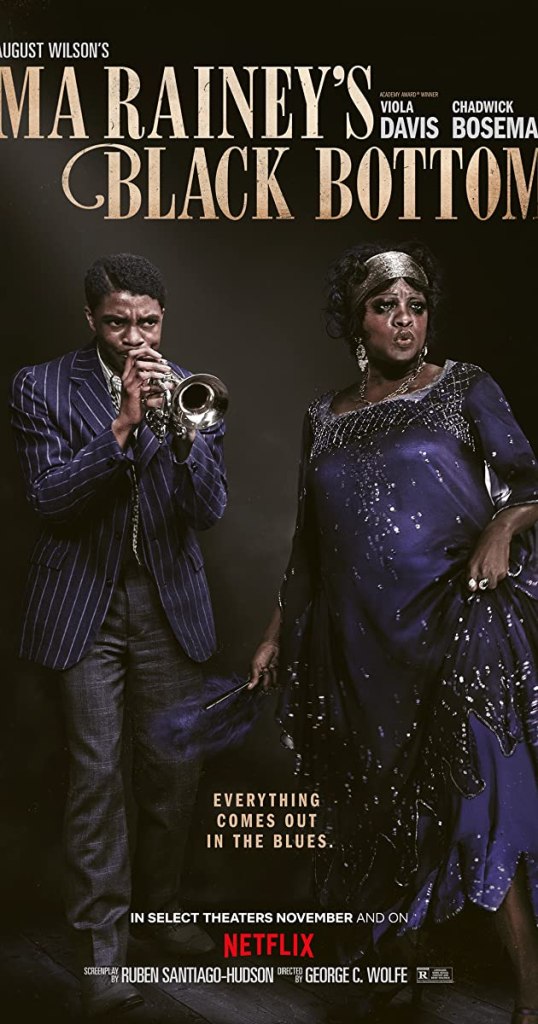
Netflix’s new movie, Ma Rainey’s Black Bottom (2020), is predicted to be in the running for the academy award of best picture. With talented actors like Viola Davis and the late Chadwick Boseman at the helm and a cerebral storyline, this comes as no surprise.
The movie, directed by George C. Wolfe, tells the story of a day at the recording studio with Ma Rainey. Netflix captions the film as, “Tensions and temperatures rise at a Chicago music studio in 1927 when fiery, fearless blues singer Ma Rainey joins her band for a recording session.”
With Davis and Boseman’s phenomenal performances, which play rather narcissistic characters, it’s easy for the film’s virtuous characters to be overshadowed. For both the purposes of balancing the storyline and integrating a deeper meaning, the piano player in Ma Rainey’s band serves an integral role.
WARNING: CONTAINS SPOILERS:
Ma Rainey’s piano player, Toledo, played by Glynn Turman, is the philosophical figure throughout the film. When Boseman’s character, Levee, insists on not practicing their musical part, a confrontation between the band members ensues.
Levee aims to get his band, as he is confident in his trumpeting talent enough not to need practice. The conversation shifts to a deeper level when Toledo speaks up about the more significant problems, that of racial injustices.
Toledo, frustrated by Levee’s laziness, says, ““I just said there’s got to be more to life than just having a good time. I said, the colored man ought to be doing more than trying to have a good time all the time.”
To stop him from continuing on with his rant, Levee plays the trumpet in his face and says, “Well, what is you doing, n***a? You’re talking all them highfalutin ideas about making a better world for the colored man. What is you doing to make it better?…”
Toledo, now angry from being misunderstood says, “It ain’t just me, fool. I said everybody. You think I’m gonna solve the colored man’s problem all by myself? I said “we.” You understand that? We? That’s every living colored man in the world got to do his share, got to do his part. I ain’t talking about what I’m gonna do or you gonna do, or Cultler, Slow Drag, anybody else. I’m talking about what all of us gonna do together.”
Toledo points to the bigger idea coming through the film, which is the manipulation of white people towards black people. The repercussions of white people manipulating Black people for their talent is the driving theme throughout the film, and Toledo is the one to voice it.
The courage it takes to voice the bigger problem is a philosophical thought that ties closely with Plato and Aristotle in their theory of the Soldier and the Citizen. Scholar for Texas A&M University, John P. Hittinger, writes an in-depth interpretation of this concept, illustrating this point.
“Aristotle defines virtue as a state of character involving choice aimed at a mean between extremes” says Hittinger.
For Toledo, that virtue is courage. He uses the opportunity in conversation with his bandmates to showcase the most pressing issue: men of color’s role in society. This courage points to justice as the primary goal, resulting in equality between the races.
Hittingger writes, “… justice, by way of courage, requires the formation of the soul and inculcation of opinion concerning the good.”
Toledo employs each of these ideals through his conversation with Levee. He uses courage as the driving force for justice. He’s done so by reading delicate literature, despite being made fun of for being a philosophical figure. His self-taught education serves as his “formation of the soul,” indicating that he is doing it for the ultimate “good.”
SPOILER: Towards the end of the film, Levee’s mistreatment from the white man boils over after being told by a white music producer only buying his song for $5. When he arrives back in the band’s locker room, he’s emotionally unstable, and Toledo accidentally steps on his shoes. Toledo’s apology goes unnoticed as Levee pulls out his knife in rage.
Toledo ends up dying at the hands of Levee’s knife in the closing scenes. This ending is extremely heartwrenching, yet it proves more of Toledo’s innocence. Toledo was a morally strong man who advocated for a significant change to occur by coming together as a community. Rather than seeing that change occur, he is killed at the hands of his bandmate.
Courage is a virtue that is difficult to speak life too, as Aristotle explains and Toledo illustrates. By choosing to be courageous and fight for the ultimate “good,” which in the movie is equality, he is murdered for such actions.
If you haven’t already, and I didn’t spoil too much, stream Ma Rainey’s Black Bottom on Netflix.

 The Beat @APU