
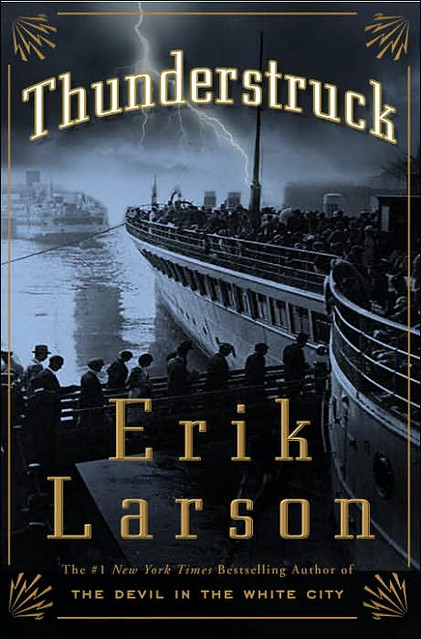
Although this book is full of intrigue, it is also a slow build.
“Thunderstruck” creates a world of intrigue through discussion about classism, politics, murder and invention. Erik Larson artfully weaves the story of the wireless telegram around a man’s unhappy marriage to create a truly captivating tale of homicide.
This story tells the stories of two men Hawley Crippen, a medical man turned murderer, and Guglielmo Marconi, an unlikely inventor, whose lives intersect during a criminal chase. Set in Edwardian London, we learn of the rise and fall of these two men.
While this book may sound fascinating, this book is for an acquired taste. If you are not interested in the politics of invention, of running a business, of Hertz and his electromagnetic theories, or how the wireless technology we have known came to be, this book is not for you.
With that warning out of the way, I will say that I thoroughly enjoyed this book despite the science going over my head. However, Marconi’s all-consuming obsession with his invention of the telegram and the politics involved in science at this time was fascinating to me.
Alongside Marconi’s life, the story of Crippen and his wife unfolds. Cora Turner was a beautiful young girl when Crippen met her. Crippen had been married once before, but at the age of 30, he became a widower. Turner had unfortunate circumstances, as her desire to become a world-renowned opera singer had left her at the hands of a man who paid for everything she needed in exchange for sex.
When Turner met Crippen, she saw him as a tool to get out of that situation. They married and it soon became clear that their marriage was not destined to be a happy one. Turner was demanding, and Crippen couldn’t meet all of her wishes because his job didn’t always generate enough money.
Because of these circumstances, the couple moved from New York City to London and the gap in their marriage grew. Eventually, both individuals had affairs and Turner changed her name to Belle Elmore.
Meanwhile, Marconi struggled with his invention taking Hertz’s experiments and tampering with them until he created something that other scientists had simply attempted. Suddenly, he was hit with fame and scientist Oliver Lodge became furious. Lodge had made several strives forward but had never continued his projects. What follows is a tale of Marconi’s journey to success.
Erik Larson is well known for his book “The Devil in the White City,” and “Thunderstruck” simply pales in comparison to this book. “Thunderstruck” takes too long with its buildup and once you are finally there, it seems to rush through all the exciting bits.
Larson also does a good job of not representing these men incorrectly. Marconi, while brilliant, is also a workaholic who lacks social astuteness. Honestly, his invention is the only thing that redeems his character. Crippen appears to be good, but eventually, he is driven to murder. Something no good man should do.
Perhaps one of the most interesting aspects of the novel is Larson’s artful look at Edwardian times. This story reveals how detective work was done back then, social calls, entertainment, inventions and the relationships that people had with others.
All of this is good, but the best part of the novel is the last 80 pages. In these pages, one begins to realize how Crippen’s and Marconi’s lives intertwine. The build is slow, a little too slow, and this is where the book fails in comparison to Larson’s other books. The amount of research Larson has done is fascinating, but it is too much for the narrative this book is trying to establish.
However, it is worth the read, but I would consider reading his other books first.

 The Beat @APU