
What we can learn from a simple episode of I love Lucy.
“Lucy, I’m home,” yelled Ricky Ricardo on the television set as nearly 70% of Americans tuned in to the most popular show on television.
Captivating an audience so wide that water usage actually decreased Mondays at 9 p.m., it is hard to not consider “I Love Lucy” one of the most popular and influential television shows to have ever aired.
What remains so interesting about the show is that it was not afraid of breaking barriers, both intentionally and intrinsically. Lucy was actually the first woman to appear on television pregnant. This was because at the time it was too promiscuous to have the audience wonder, “How did that baby get there?” The show went so far as to separate Lucy and Ricky’s beds.
Of course, pregnancy, and now extraordinarily provocative behavior, is not only allowed but glamorized on television. This is probably due in part to the fact that Lucy’s birthing episode garnered a whopping 44 million viewers, in a time pre-DVR.
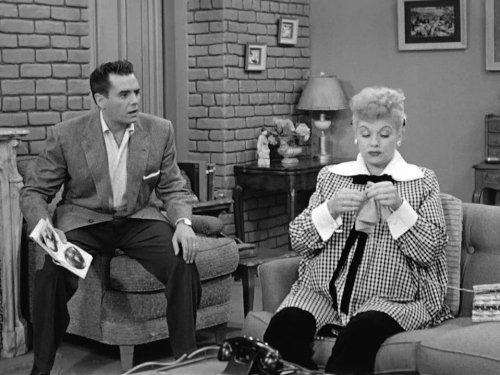
What makes “I Love Lucy” notable, however, is not that it was able to garner so many views, and laughs, but that its lessons are timeless and worthy of being emulated.
Recently, after watching “Being the Ricardos,” a beginners guide and behind the scenes of Lucy and Ricky in real life, I found myself searching every dark section of the internet to watch any episode of the comedy show I could get my hands on.
It was not until an episode on feminism that I realized that the show still had some worthwhile commentary on politics.
What starts off as a gag about Ricky not putting on Lucy’s coat, holding the door open for her, or pulling out her chair reveals something so much deeper about feminism.
“I wish there were something besides men to marry,” Lucy comments during the episode after her Cuban husband remarks about her allowance.
The episode revolves around the joke that if Lucy wants to be treated like a man, Ricky will do just that. Eventually, when left with the bill at dinner, Lucy realizes that there is inherent good to the fact that she and her husband play different roles in their relationship.
After an entire episode of poking fun at the idea of “equal rights,” the show has both promoted family values and made a comical sketch out of the feminist movement.
Now, politically inclined or not, the show’s comedic moments are uniquely funny, and the episode had the guts to point out what it saw as inconsistencies in the current political sphere.
“I Love Lucy” perfectly walks the line between politically incorrect and value-driven comedy. By maintaining root in the idea of a loving husband and wife starting a family, while also partaking in the social-political movements, the show both maintains relevance, and contains lessons on how to perfectly construct a national comedic hit.
If today’s comedies do not abandon their need to be politically correct and forgo all ideas of a stable family structure, I am not convinced that 70% of Americans will ever be watching anything together — and that is just sad enough to make poor Lucy cry, again.

 The Beat @APU