
German filmmaker, Werner Herzhog, creates film on a controversial figure.
In Werner Herzhog’s documentary film, Grizzly Man (2005), audiences experience the extreme life that subject Timothy Treadwell lived.
Treadwell spent 13 summers living among Grizzly bears in the northern region of Alaska. He identified himself as a “master, yet a kind warrior” who was present in bear country for the protection of the grizzlies and the education of the public.
The documentary, which has a runtime of 1 hour and 44 minutes, consists of interviews with those who knew the “Grizzly Man” spliced between footage of Treadwell’s final summers.
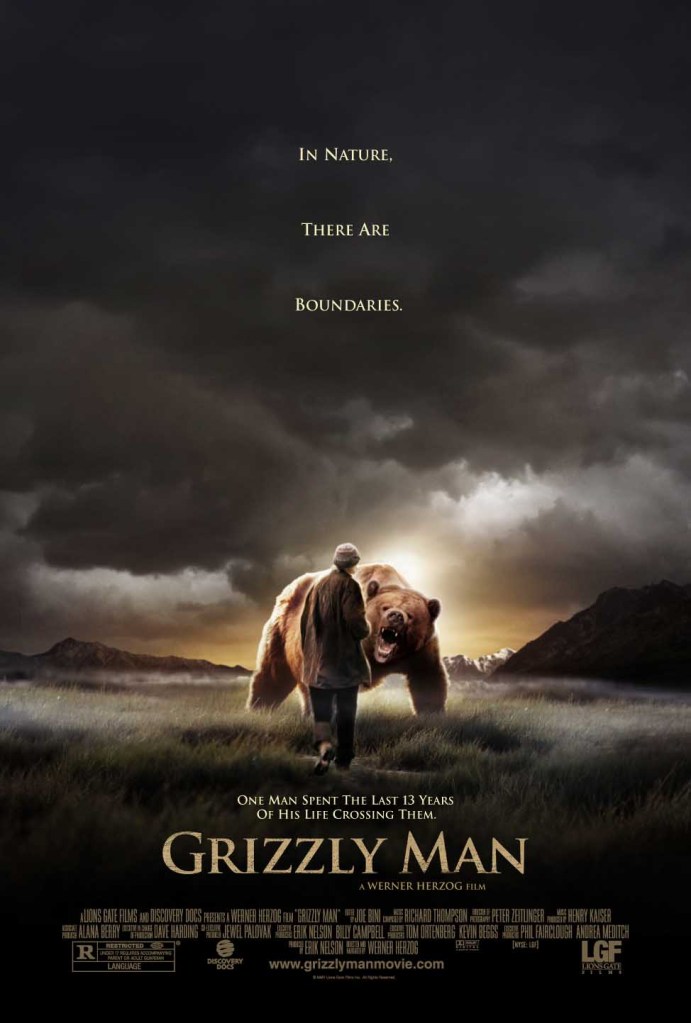
At the outset of the film, the tone is optimistic. Music swells as a wide angle shot displays grizzly bears walking about a lush field. Yet, sauntering into the foreground comes Treadwell, a slender and tall man who looks like a cross between a G.I. Joe and a California surfer.
In the film’s opening remarks, Treadwell is heard calling the two nearby bears by name, Ed and Rowdy. Despite calling upon them sweetly by name, he describes how he must be defensive, otherwise the bears will “decapitate him.” Serving as a foreshadowing of what is to come, Treadwell sits confidently in these wild animals’ territory, knowing very well that his life may be “on the precipice of death.”
“I love them with all my heart … I will die for them … but I will not die at their claws and paws,” he firmly remarks. Following this statement, Treadwell returns to his loving self, blowing a kiss to the bear he calls “Rowdy.”
Director Werner Herzhog narrates Treadwell’s summers living out in the open country over found footage from Treadwell’s camera. “Having myself filmed in the wilderness of jungles, I found that beyond the wildlife film in his material lay dormant a story of astonishing beauty and depth,” he says. There was a “desire in him to leave the confinements of his humanness … seeking a primordial encounter. Yet in doing so, he crossed a primordial borderline,” Herzhog candidly remarks.
Here emerges the theme of the film: the boundary between human and animal. The film’s title, “Grizzly Man” speaks to this grotesque borderline, one that Treadwell crossed at the cost of his own life.
In most documentaries I have watched, the views and opinions of various interviewees are presented for what they are, rendering the role of the filmmaker behind the camera or editing board to be a mere herald of information. However, Herzhog takes no issue with being a biased narrator.
This does not necessarily taint the documentary as a whole; rather, it sheds light on the fact that Treadwell put himself at risk. Not only this, but through his presence among the grizzlies, he made them more acquainted with humans, perhaps making them more susceptible to poachers in Herzhog’s view.
Sam Egli, an Alaskan aviator who was dispatched to assist in the cleanup following the “Treadwell Incident,” stated his disappointment in Treadwell.
“Treadwell was, I think, meaning well, trying to do things to help the resource of the bears. But, to me, he was acting like he was working with people wearing bear costumes out there, instead of wild animals … He got what he deserved in my opinion,” Egli stated.
I found Egli’s comments to be eyeopening, as criticism of Treadwell’s mission had yet to be openly documented. He concluded with a statement that deeply sparked my interest in the rest of the film: “The tragedy of it was taking the girl with him.”
Questions such as, “Who was this girl?” were prompted in my mind. Part of this film’s mastery is the fact that Herzhog keeps on adding details into the narrative that will not be fully fleshed out until later in the film.
Soon enough the audience meets Jewel Palovak, Treadwell’s ex-girlfriend of three years. Though they split up, they maintained a good relationship with one another and Palovak became the inheritor of Treadwell’s meager estate.
She never accompanied Treadwell on his escapades, but there was one girl who did, Amie Huguenard.
“Amy was brave. Amy was strong. Amy was my friend,” Palovak commented. “I am always going to respect them for what they did … for protecting bears,” she said with tears in her eyes. “They truly died doing what they lived for.”
Amie’s family has avoided the media and denied a request from the film’s production team to be interviewed. For this reason, very little is known about Amie.
In the film’s most brutal moment, Herzhog asks Palovak is he can listen to the recording of Treadwell and Huguenard’s deaths. The film grows eerily silent as the director places the headphones on to listen to the tape.
Before their death, Treadwell had set the camera to record but had not yet removed the camera lens cap before he was attacked by a bear, leaving us only with audio. In a panic, Huguenard grabs a frying pan and smacks the bear that stands over Treadwell multiple times. As Treadwell lies dying, he commands her to run, but in shock she remains by his side, being eaten by the bear as well.
From an overall standpoint, the documentary is appropriately informative and emotional, ending on a somber note that remembers Treadwell honestly, reminding viewers of the simultaneous beauty and danger of nature.

 The Beat @APU